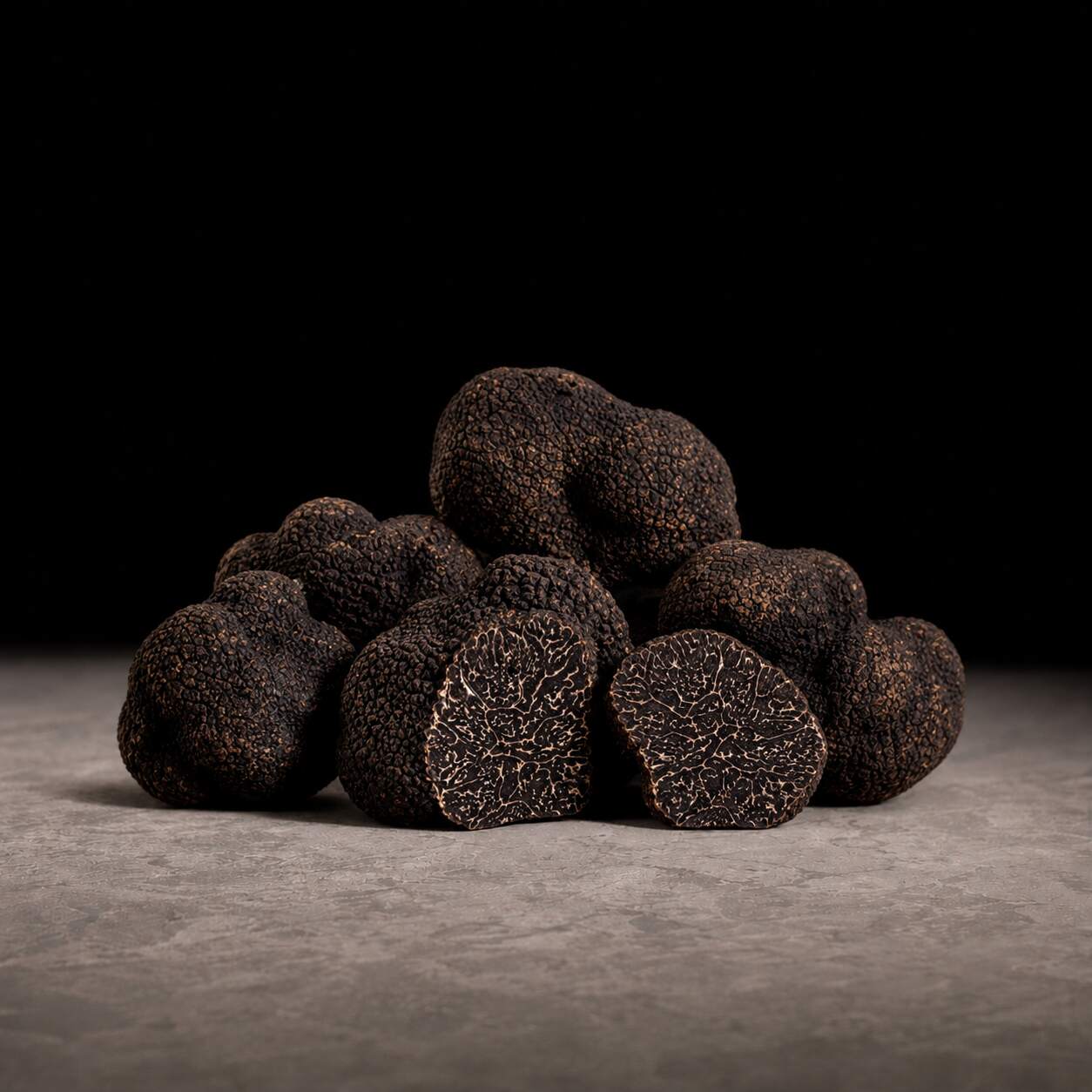
American Truffle Company grows Périgord black truffles in America, harvests to order, and delivers them ultra-fresh, overnight.
Two decades to get here. One night to reach you. The aroma says it all.
2003 · Munich
Munich, 2003: the plate of pasta that started American Truffle Company
American Truffle Company began with a handwritten menu special in a Munich trattoria in 2003, and a question its founder couldn’t put down: could Périgord black truffles be grown in America?
By then Robert Chang had eaten his way across three continents — balut in Saigon, percebes off the Costa da Morte in Galicia, fugu in Shimonoseki, mullet roe from southwestern Taiwan, and sea urchin cracked open on the deck of a Hokkaido fishing boat. Almost none of it was pretty. All of it was worth the trip.
He had never eaten a truffle.
He was two years into a posting in Germany — there for the same reason he had gone to Japan a decade earlier, curious how a country flattened by a war rebuilds itself into an economy — when he found the special chalked up in an Italian place in Munich. Tagliatelle, butter, shaved black truffle. He ordered it.
He was hooked immediately. Not by the look of it, which was a simple plate of buttered pasta, but by the extraordinary aroma, which was like nothing he had encountered on three continents.
The question followed him back to California. He went looking for someone who could answer it — across Europe, North America, Australia, New Zealand. There was no shortage of experts. Nearly all of them offered folklore: methods handed down, results promised, nothing that could be tested, published, or repeated. He wanted evidence.
Almost nobody had any.
Except one.
2006 · London
A pub in Leicester Square: how Robert Chang and Paul Thomas founded American Truffle Company
American Truffle Company was founded in 2007 by Robert Chang as Managing Director and Chief Truffle Officer, and Paul Thomas as Chief Scientist.
The exception Robert had been looking for was a newly minted PhD named Dr. Paul Thomas. Sheffield, 2004, dissertation on truffle cultivation. Unlike every other expert Robert had found, his claims arrived with data attached. Robert found him online in 2006, and flew to London to meet him in person, in a pub off Leicester Square.
Neither of them knew, sitting down, that they had already made the same decision — separately, years apart, more than once each.
Robert had made it at sixteen, applying out of a rural North Carolina high school to the North Carolina School of Science and Mathematics. He made it again transferring out of Caltech to Stanford, trading a narrower path for a curriculum that would also let him study philosophy and history and learn languages. And he had just made it a third time, discarding a continent’s worth of confident truffle experts because none of them could show their work.
Dr. Thomas had made it on television. In 2005 he brought his truffle cultivation company, Mycorrhizal Systems Ltd., onto the BBC’s Dragons’ Den — five investors, three of whom told him on camera it would never work. He held his structure anyway: land, not cash; a profit share, not a flat fee. Simon Woodruff met him on those terms, at 25%. Then, afterward, Paul walked away from the deal.
He had also built something unconventional. Rather than sell consulting hours, Dr. Thomas partnered with growers and shared the revenue with them — his own invention, already running in the UK. He only got paid when the truffle came. That was the whole pitch.
Two people who had each taken the harder road, every time it was offered.
American Truffle Company was founded in 2007, with Paul’s partnership model extended to North America and Robert running the American operation.
Robert Chang
Managing Director & Chief Truffle Officer
- Born in Taiwan; in the United States since he was twelve
- B.S. and M.S., Electrical Engineering, Stanford University
- MBA, Stanford University
- Bosch Foundation Fellow
- Formerly global product marketing at Yahoo; CEO of a software startup
- Speaks English, Mandarin, Japanese, German, and Spanish
- Has eaten his way across five continents
- Founded American Truffle Company in 2007
The method
The science behind ATC: Professor Paul Thomas, Chief Scientist
ATC’s cultivation method is the work of Professor Paul Thomas, the company’s Chief Scientist — a mycologist with a Ph.D. from the University of Sheffield, more than 40 peer-reviewed scientific papers, and research sites on four continents.
Growing a Périgord black truffle is not planting a crop. It is establishing a living partnership between a fungus and the roots of a tree, then holding soil chemistry, climate, and orchard management inside a window narrow enough that the fungus will fruit — sometimes a decade after the tree goes in. Most of what goes wrong goes wrong at the very beginning, in the nursery, where a tree that was never properly colonized looks exactly like one that was.
ATC’s trees come from a certified Oregon truffle-tree nursery with DNA and mycorrhizal verification: every tree confirmed at a genetic level to be carrying the right fungus before it is ever planted. The inoculation protocol behind it has produced truffles on four continents.
Here is why that belongs on a page about your dinner rather than in a journal. Reliable cultivation in America means the orchard is a domestic flight from your kitchen instead of an ocean and a customs line. That proximity is what makes Harvest On-Demand possible — your truffle harvested and shipped the same day, the day before it’s delivered, and sent overnight by an Express carrier. Aroma is perishable. Everything upstream of your door exists to protect it.
It’s no wonder that a founder who trusts his nose built a company on aroma. Years before Munich, walking down a street in Poland, Robert caught the exact same smell of the beef soup of his childhood in Taiwan — a scent that had crossed two oceans and thirty years and arrived intact. ATC grades every truffle on aroma first for the same reason. Aroma is what survives. Aroma is flavor.
Prof. Paul Thomas
- Chief Scientist, American Truffle Company
- Managing Director and lead researcher, Mycorrhizal Systems Ltd. (UK)
- Honorary Professor, University of Stirling (since 2020)
- Ph.D., University of Sheffield
- 40+ peer-reviewed scientific papers
- Research sites across four continents
The record
Peer-Reviewed Research: Selected Publications
Seven of Prof. Thomas’s 40+ peer-reviewed papers, selected for their bearing on truffle cultivation. Anyone can claim a method works. This is the record of it being tested, reviewed by other scientists, and published where it can be argued with.
- Thomas, P. Edible fungi crops through mycoforestry, potential for carbon negative food production and mitigation of food and forestry conflicts. Proceedings of the National Academy of Sciences, 120(12), 2023.
- Thomas, P. Hunting dog behaviour is a key driver impacting harvest quantity and quality of truffles. Scientific Reports (Nature Portfolio), 15(1), 2025.
- Thomas, P. Risk and reward of the global truffle sector under predicted climate change. Environmental Research Letters, 17(024001), 2022.
- Thomas, P. A risk assessment of Europe’s black truffle sector under predicted climate change. Science of the Total Environment, 655(2), 2018.
- Thomas, P. First harvest of Périgord black truffle in the UK as a result of climate change. Climate Research, 74(1), 67–70, 2017.
- Thomas, P. An analysis of the climatic parameters needed for Tuber melanosporum cultivation incorporating data from six continents. Mycosphere, 5(1), 137–142, 2014.
- Thomas, P. The role of pH in Tuber aestivum syn. uncinatum mycorrhiza development within commercial orchards. Acta Mycologica, 47(2), 161–167, 2012.
The proof
Sonoma, 2018: the first Périgord black truffle in North America cultivated using ATC’s scientific methods
Yes, it works, and here is the date. On December 11, 2018, an orchard in Sonoma County — owned by ATC partner grower Sandy and her late husband Paul, and managed by Chris — produced the first Périgord black truffle in North America cultivated using ATC’s scientific methods. Chris found it with the help of Bella, his truffle-trained Border Collie.
Seven years of soil tests, root tests, and diligence, with nothing to show anyone. The trees went into the ground in 2011. Robert was there with Sandy, Chris, and the ATC team when it finally came out. Paul was in his office in Scotland — he was beside himself when Robert told him.
Chef Ken Frank of Michelin-starred La Toque was there for the weighing in, ingredients already in hand to cook with it on the spot.
The perfume was tremendous. This is the real thing and a game changer for us chefs!Chef Ken Frank · La Toque, Napa
Five years later, at Roger’s orchard, ATC recorded a four-year first harvest — the first and fastest anywhere in North America. This time Paul was in the orchard, holding the pile, and both he and Robert can attest to what came up with it: the same tremendous aroma.
Holy smoke, these truffles have incredible aromas!Robert Chang
They were also large: seven truffles that day, ranging from 44 to 104 grams, two of them clearing 100 grams apiece.
One harvest · seven truffles · weighed on the orchard scale (grams)
- 103.94g
- 100.71g
- 94.60g
- 61.61g
- 46.33g
- 46.01g
- 44.36g
Size is the part that photographs. It is the aroma we grade on.
Our first orchard took seven years. Then came the North American record: four.
Our grower-partners
Meet the growers and dogs who find your truffle
Every ATC truffle is grown and harvested by a partner grower — real farms, real families, and a dog with its nose in the dirt.
They work under the model Paul built before there was an American Truffle Company: we take a share of what the orchard produces rather than a consulting fee, which means we are paid when our growers are paid and not before. It is the least convenient way to run this business. It is also the only version where everyone at the table wants the same thing.
You’ll meet them properly. Every shipment carries a QR code that opens a page belonging to that truffle alone — the date and hour it was harvested, the farm, the region, the hunter’s name, the dog’s name, and a film shot on that farm. Meet the hunter and dog who hunt the farm your truffle came from.
We’ll tell you the region. We won’t tell you the coordinates. Those grounds have been guarded for generations, and we’re not the ones to stop.
The ones actually doing the work
In the world
The Napa Truffle Festival, and the rest of the truffle world
American Truffle Company founded the Napa Truffle Festival in December 2010 and has presented it every January since 2012 — bringing Michelin-starred and master chefs, growers, scientists, dogs, and anyone curious enough to show up into the same few days in Napa Valley.
Chef Ken Frank of Michelin-starred La Toque in Napa has cooked with truffles for more than 35 years — widely considered the top truffle chef in North America, and the first and only American chef invited to the Fiera Internazionale del Tartufo Bianco d’Alba (International Alba White Truffle Festival), where he was knighted by the Order of the Knights of the Truffle and Wines of Alba. He’s also host chef of the Napa Truffle Festival. In his 42nd year running an all-black-truffle menu, he has gone through, by his own count, a couple of tons of truffles. He cooks with our truffles, and so do others: these are the same truffles we supply to Michelin-starred American kitchens.
The work runs well past Napa. Robert speaks five languages — English, Mandarin, Japanese, German, and Spanish — which is why he has been invited to address Spanish truffle festivals and congresses in Spanish rather than through an interpreter. Those conversations have become working relationships across Spain, Italy, Argentina, Chile, and Australia. Truffle growing is a small world that talks to itself in half a dozen languages, and we are in the room for most of it.
Ken Frank, reactions
We’ve supplied truffles straight from the orchard to Ken’s kitchen, sometimes with camera rolling, and handed them over before he knew what was coming. Here’s what happened when he got his hands on them.
This size and shape, this is the top grade. And really what I buy on is perfume — and this perfume is money.Chef Ken Frank
Nobody has a fresher truffle in California than this one right here tonight, period.
We just got the best truffles of the season from Europe yesterday, and this — super dark, aromatic — this is right there with them. This is a world-class truffle.Chef Ken Frank
AS FEATURED IN
-

Fox News Highlights ATC & the Napa Truffle Festival
-

ABC News Covers Icon Truffle Harvest
-

Truffle Treasures Unearthed
-

A $973 Fungus – and How You Can Get Some
-

CBS News Highlights ATC Truffle Harvest
-

Truffle Economy: How a Scientist Sniffed Out a Culinary Opportunity
-

Has A Start-Up Found the Secret to Farming the Elusive Truffle?


Every truffle has a story
We mean it literally. Every truffle we ship arrives with a code that opens its own biography — the farm it grew on, the region, the hunter who walked the rows, the dog who stopped, the date and hour it came out of the ground.
It seemed like the least we could do for something that took us seven years, then four, and the better part of two decades of refusing to take anyone's word for it.
Northern Hemisphere season runs early December through the second half of March in a normal year. Out of season, you can reserve your place in the next harvest.