Original article from The Press Democrat

Photo credit: Beth Schlanker for The Press Democrat
By Sasha Paulsen
The Press Democrat
Zara sniffed the ground beneath a sprawling oak tree, her sharp nose sweeping the soil with precision. The 6-year-old Lagotto Romagnolo — a breed renowned for its truffle-hunting prowess — paused, signaling her human companions to take over.
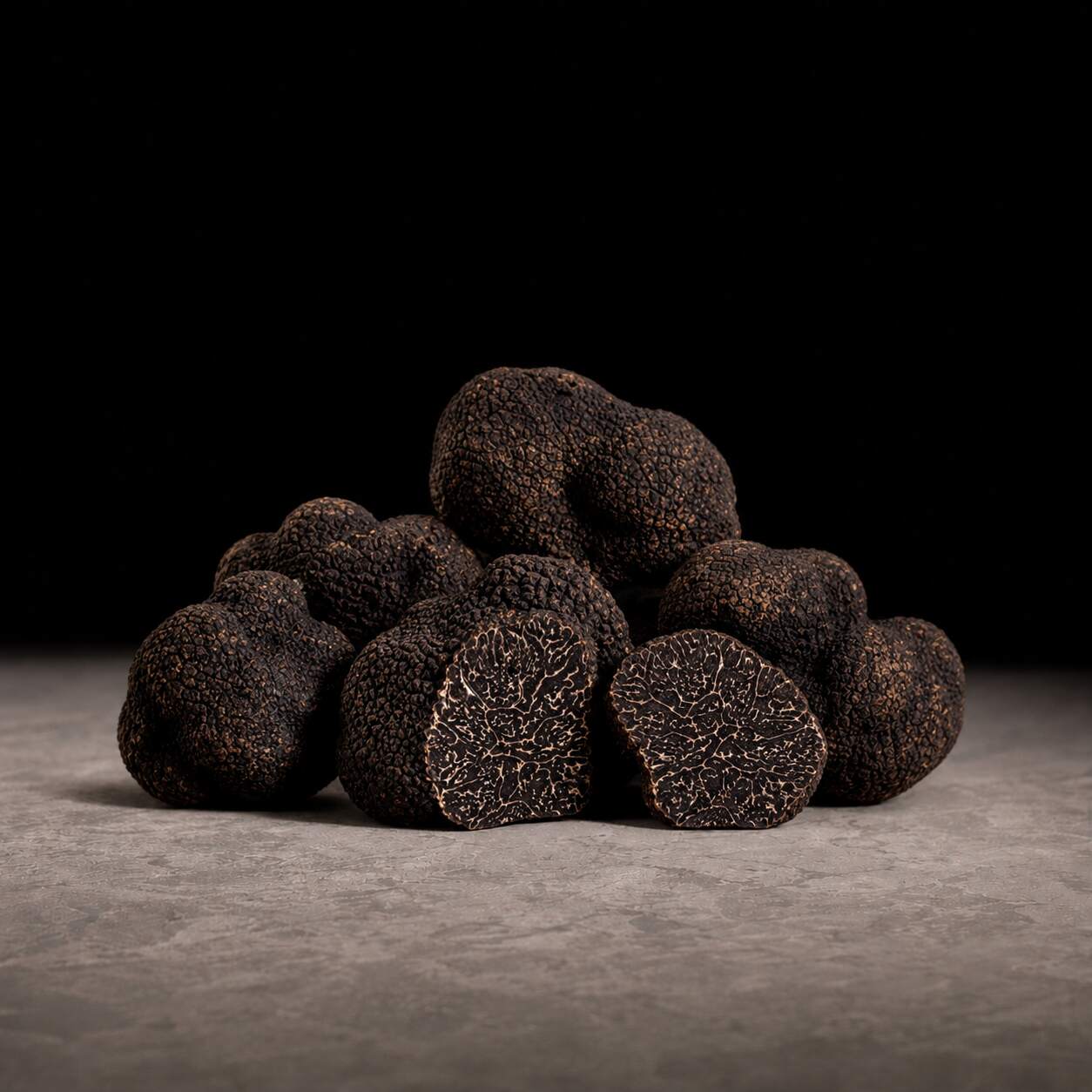
Her trainers, Bill Collins and Lynell Heatley, dropped to their knees and joined the search, their hands combing through the earth. Moments later, they unearthed their prize: a fragrant Périgord black truffle.
Zara and her team were part of this weekend’s 12th annual Napa Truffle Festival, gathering enthusiasts, scientists and chefs to celebrate the elusive and aromatic delicacy. Held at an orchard nestled in Napa’s northeastern hills, the event highlighted the growing success of locally cultivated truffles.
The orchard, planted in 2017 with inoculated oak and hazelnut trees, is among several partnerships facilitated by the American Truffle Co. Founders Robert Chang and Paul Thomas have been cultivating truffle orchards across the U.S. since establishing the company in 2007. The site produced its first truffles two years ago, yielding increasingly impressive finds, including last year’s “icon-status” truffle.
This doesn’t happen by luck, according to Chang.
“We work with the partner-clients to prepare the environment to be ready for the trees as well as the truffle fungus,” he said. “You plant and then you wait. But in the meantime, you have to take care of the orchard. A lot of people haven’t gotten very far with the truffles. They would just plant the trees and hope, but it is not that simple.”
While it typically takes five to seven years for truffle production, Napa’s orchard produced results in just four years. This season’s hunt yielded a particularly exciting discovery: a massive truffle weighing 400 grams, about the size of a small cauliflower.
Current prices from online gourmet shops are listing the black Périgord truffle, favored by chefs, at about $69 an ounce. (If the pricing holds true, the whole truffle would cost about $973.56.)
It’s “a game-changer,” said Michelin-starred chef Ken Frank of La Toque in Napa. “A nice truffle. A good size. Good perfume.”
Frank, who has been hosting his six-course All Black Truffle Dinner for 43 years, emphasized the importance of freshness. Imported truffles from Europe often lose their potency during shipping.
Truffles have a half-life of about five days, Frank explained. By this time, half of their aroma and flavor has dissipated. By the time European truffles reach U.S. kitchens, half their flavor and aroma are gone. Local truffles can be served at their peak — hours after harvest.

Photo credit: Beth Schlanker for The Press Democrat
The journey to Napa-grown truffles
Chang’s fascination with truffles began during a trip to Germany in the early 2000s. After tasting a simple dish of tagliatelle with butter and fresh black truffles, he was hooked.
“Love at first bite,” he recalled.
Returning to Silicon Valley, Chang, an engineer by trade, began exploring the feasibility of growing truffles in the U.S. His search for a scientific partner led him to Paul Thomas, a Scottish researcher who had spent his academic career studying truffle cultivation.
Truffles are an intersection of nature, science — and patience. Although they occur naturally in places like Italy and France, the majority of truffles are now cultivated. In France, for example, 95% of their truffles are farmed rather than foraged, Thomas said.
Thomas’ expertise has guided successful cultivation projects worldwide. The American Truffle Co. integrates his methods, combining advanced research with tailored support for orchard owners.
The work, Chang said, “is 100,000 times better than engineering. More interesting and more fun.”
A growing truffle scene
The Napa Truffle Festival has become a platform to showcase these local treasures. Last year marked the first time locally harvested truffles were featured in festival dinners, and this year, they will also be available for purchase at Napa’s Oxbow Public Market.
For Chang, Thomas and chefs like Frank, the rise of American truffle cultivation is a significant milestone.
It’s an exciting time for truffle lovers, Frank said. Having fresh, locally harvested truffles is not just a luxury — it’s a revolution for American cuisine. And “the fresher the better.”
Leading the charge, with her finely tuned nose, is Zara, the unassuming star of the Napa hills.